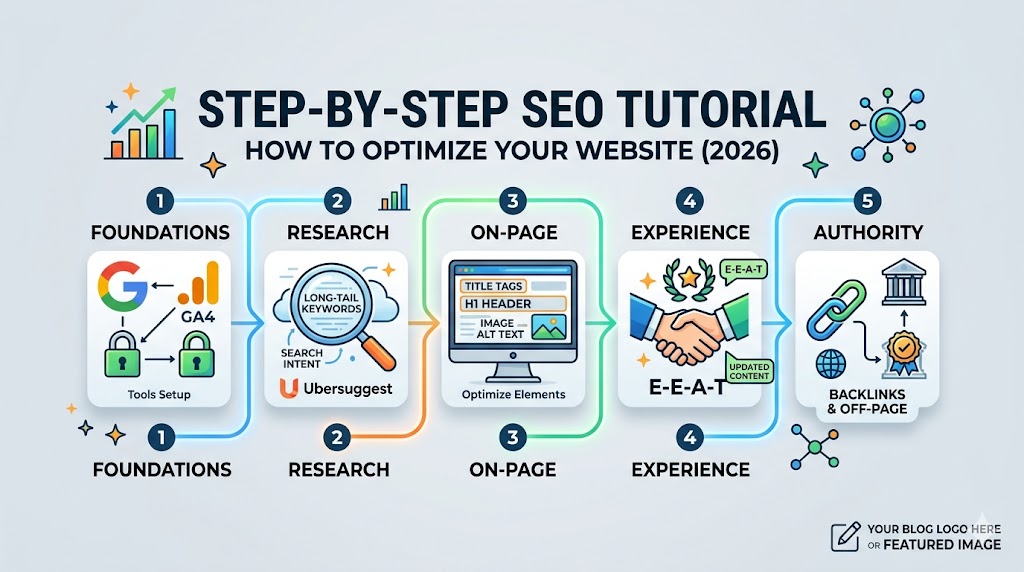
SEO is no longer just a “plus”—it’s the engine that drives sustainable growth for any digital presence. While it might seem like a maze of technical jargon, breaking it down into a logical flow makes it manageable for any site owner.
Here is your step-by-step roadmap to mastering SEO in 2026.
Phase 1: Technical Foundations
Before you worry about what’s on the page, you must ensure Google can actually “see” and “read” your site. This is known as Technical SEO.
- Setup Essential Tools: Connect your site to Google Search Console to monitor indexing issues and Google Analytics 4 to track how users behave once they arrive.
- Secure Your Site: Use HTTPS. Security is a non-negotiable ranking factor.
- Mobile-First Indexing: Google primarily uses the mobile version of your content for indexing and ranking. Ensure your design is responsive.
Phase 2: Strategic Keyword Research
Keywords are the bridge between what people are searching for and the content you provide.
- Identify Intent: Don’t just look for high volume; look for intent. Are they looking to buy (Transactional) or just learn something (Informational)?
- Target Long-Tail Keywords: Focus on specific phrases (e.g., “how to do SEO for a small business website”) rather than broad terms like “SEO.” These are easier to rank for and often convert better.
- Use Modern Tools: Leverage Keyword Research Tools to find high-opportunity, low-competition gaps in your niche.
Phase 3: On-Page Optimization
This is the process of optimizing individual web pages to rank higher.
- Title Tags & Meta Descriptions: Write unique, compelling titles (under 60 characters) and descriptions that encourage clicks. Include your primary keyword near the beginning.
- Header Tags (H1-H3): Use H1 for your main title and H2s/H3s for subtopics. This helps Google for Developers understand the hierarchy of your information.
- Image Alt Text: Search engines can’t “see” images, but they can read the alt text. Describe the image accurately while including relevant keywords.
Phase 4: Content Experience (The “E-E-A-T” Factor)
Google prioritizes content that demonstrates Experience, Expertise, Authoritativeness, and Trustworthiness.
- Satisfy Search Intent: Your content must actually answer the user’s question. If a user clicks your link and immediately leaves (bounces), Google will drop your ranking.
- Regular Updates: Search engines love fresh content. Revisit old blog posts to update stats, links, and advice.
- Readability: Use short sentences, bullet points, and clear headings to make your content “skimmable.”
Phase 5: Authority & Off-Page SEO
Once your site is polished, you need to prove to Google that the rest of the internet trusts you.
- Internal Linking: Link your new posts to existing high-authority pages on your own site. This helps “pass the power” (link equity) around.
- Backlink Building: Earn links from reputable websites. Guest posting, original research, and content marketing are the most effective ways to build a natural backlink profile.
SEO Success Checklist
| Step | Action | Priority |
| 1 | Verify site on Google Search Console | Critical |
| 2 | Optimize for Mobile & Speed | High |
| 3 | Map Keywords to Pages | High |
| 4 | Fix Broken Links (404s) | Medium |
| 5 | Add Schema Markup | Medium |
SEO is a marathon, not a sprint. By following these steps consistently, you’ll build a site that doesn’t just rank for today, but stays relevant for years to come.