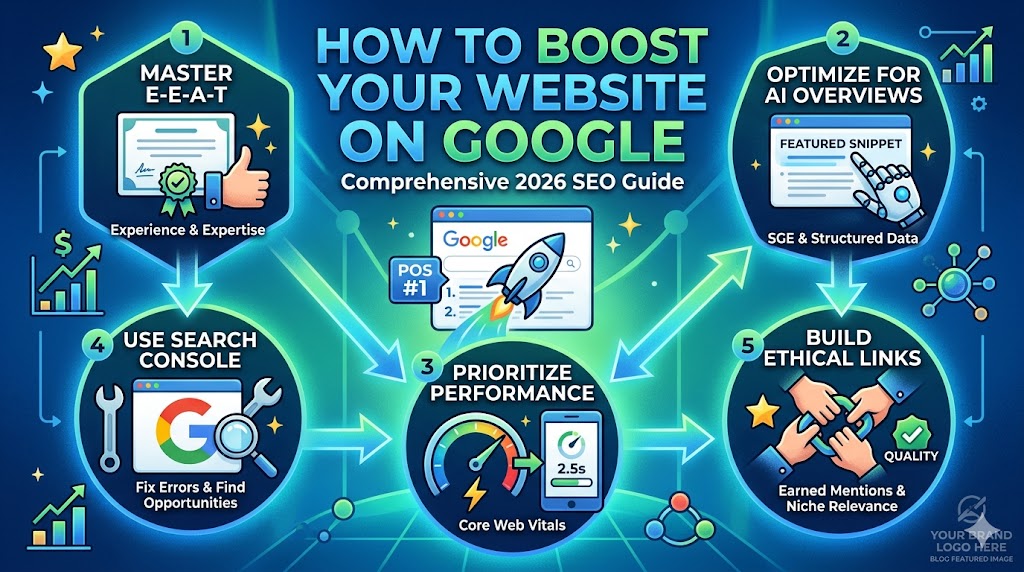
In 2026, boosting a website on Google is no longer just about “stuffing keywords” into a page. With the rise of AI Overviews (SGE) and generative search, Google now prioritizes content experience (CX) and real-world expertise.
Here is a comprehensive guide to boosting your rankings in the current landscape.
1. Master the “New” SEO: E-E-A-T
Google’s ranking systems are now strictly tuned to Experience, Expertise, Authoritativeness, and Trustworthiness. To boost your site:
- Show First-Hand Experience: Use “I” or “We” and include original photos, case studies, or personal insights that AI cannot easily replicate.
- Author Profiles: Ensure every blog post has a clear Author Bio detailing their professional background and real-world qualifications.
- Citations: Link to reputable sources and include a “last updated” timestamp to show content freshness.
2. Optimize for AI Overviews (SGE)
Google’s AI often summarizes the best answer at the top of the page. To get featured:
- Be the Direct Answer: Use clear, concise headings that pose a question (e.g., “How do I boost my site?”) followed by a direct 2-3 sentence answer.
- Structured Data: Use Schema Markup (FAQ, How-to, or Product schema) to help Google’s AI easily “read” and extract your data.
- Topical Authority: Instead of targeting one keyword, build “Content Hubs.” Create one massive pillar page and link to 5-10 smaller, detailed “cluster” articles.
3. Prioritize Performance (Core Web Vitals)
Technical health is a “barrier to entry.” If your site is slow, you won’t rank, regardless of content quality.
- LCP (Largest Contentful Paint): Your main content should load in under 2.5 seconds.
- CLS (Cumulative Layout Shift): Ensure buttons and text don’t “jump” while the page is loading.
- Mobile-First Design: Since 2025, Google almost exclusively indexes the mobile version of your site. Test it on a phone, not just a desktop.
4. The Power of Google Search Console (GSC)
GSC is your most important free tool. Use it to find “Low-Hanging Fruit”:
- Identify Position 11-20 Keywords: Look for keywords where you are currently on page 2. Adding a new image, an FAQ section, or an internal link can often push these to page 1.
- Fix Indexing Errors: Check the “Indexing” report regularly. If Google can’t crawl your page, it doesn’t exist to the world.
- Branded vs. Non-Branded: Use the new branded query filters in GSC to see if people are finding you by name or by the services you offer.
5. Build Authority with Ethical Links
Backlinks remain a top ranking factor, but quality beats quantity every time.
- Earned Mentions: Create original research, infographics, or tools (like calculators) that other websites want to link to.
- Niche Relevance: One link from a high-authority site in your specific industry is worth more than 100 links from unrelated “link farms.”
- Internal Linking: Help Google discover your new content by linking to it from your highest-performing existing pages.
Quick “Boost” Checklist
| Action Item | Frequency | Impact |
|---|---|---|
| Update Old Content | Quarterly | High |
| Check Page Speed (PageSpeed Insights) | Monthly | Medium |
| Monitor GSC for Errors | Weekly | High |
| Add Internal Links to New Posts | Every Post | Medium |
Export to Sheets
Final Tip: Don’t write for Google; write for the person searching. If users stay on your page, click your buttons, and don’t immediately “bounce” back to search results, Google will recognize your site as high-value and boost you naturally.